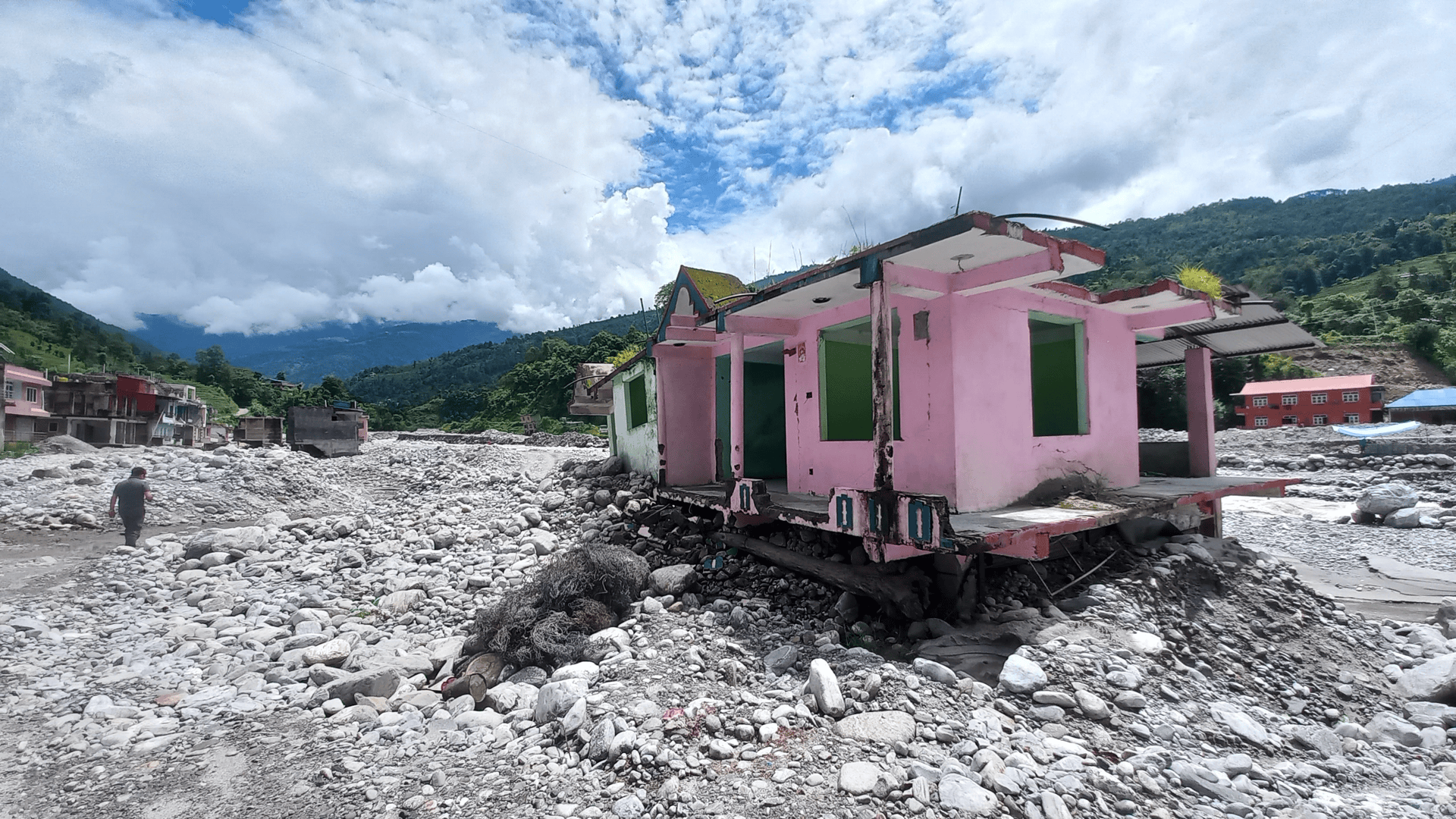
On 26 August, a huge rock-ice avalanche from Langtang Lirung and the flood that followed it devastated Nepal’s Rasuwa district. More than 1,400 people died, more than 5,000 are still missing, and tens of thousands have lost their homes. Our thoughts are with the affected communities.
A Comment published in Nature on 20 October looks at what this and other recent extreme events in mountain regions mean for how risks are assessed and managed. It was led by Christian Huggel (University of Zurich), and one of its co-authors is our colleague Jakob Steiner, senior engineer at hydrosolutions and postdoctoral researcher at the University of Graz. Congratulations, Jakob!
The authors argue that current approaches are no longer enough. Hazards now go beyond anything in the historical record, so probabilistic analysis needs to be complemented by physically plausible scenarios and storylines of cascading impacts. Affected people also need to be part of an open discussion about risk tolerance and residual risk.
The same questions run through our own work in Nepal. Under SDC’s ReCAP programme, we have estimated rare monsoon floods with return periods of 100 to 500 years in the Dudh Koshi basin. With the Universities of Zurich and Geneva, we also stress-tested compound events that combine monsoon floods with glacial lake outbursts. Climate change is explicitly built into these scenarios, so the assessment goes beyond historical precedent. Under future climate conditions, the 100-year flood peak increases by about 40% to 90%. Events on the scale of Rasuwa remain beyond what we can anticipate. They remind us how much is still unknown, and how important it is to make uncertainties clear to the people who have to make decisions.
Read the Comment: Huggel, C., Allen, S. K., Mark, E., Shugar, D. H., Steiner, J. & Upadhyay, K. Nepal’s disaster is an urgent wake-up call. Nature 658, 868-871 (2026). https://www.nature.com/articles/d41586-026-03314-6